
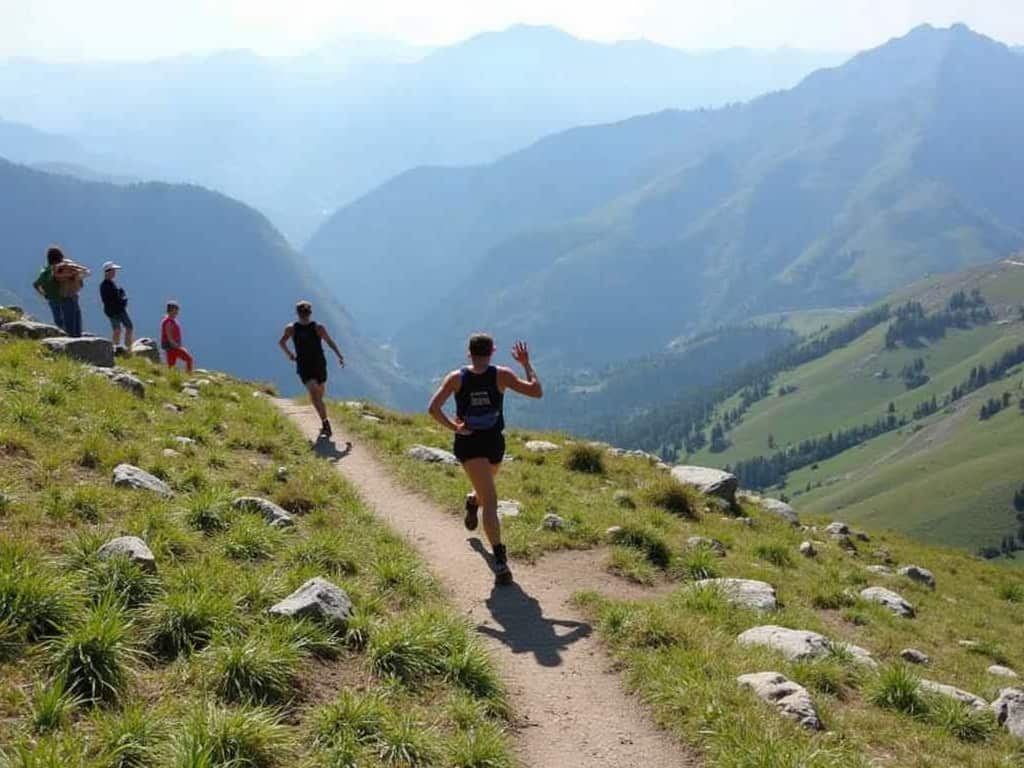
Most people who start mountain running don't plan to. They get bored of flat road loops, someone dares them up a hill, and suddenly they're hooked on something that hurts more, costs more, and takes longer than anything they did before. That's the whole point, really.
Mountain running has exploded over the last decade. Ultras sell out in minutes, gear companies now sponsor people who run ridgelines at 4am, and there's an entire category of runner who plans holidays entirely around routes they saw on Strava. If that sounds like you — or someone you're about to become — here's where the world's best mountain terrain actually is, and what it's genuinely like to be on it.
The Alps: Where Everyone Goes First, And Honestly, Fair Enough
Chamonix is the obvious starting point and it doesn't apologise for it. The Tour du Mont Blanc — 170 kilometres, roughly 10,000 metres of elevation gain, looping through France, Italy, and Switzerland — is the route that turns runners into obsessives. Most people hike it over 11 days. Runners do it in under 24 hours. Some do it alone at night, which says something about runners as a species.
The UTMB race has made Chamonix the mountain running capital of the world in a commercial sense, and that comes with trade-offs. The trails in peak season are genuinely crowded. You'll share the Balcon Sud with day hikers, families, and people in jeans who've taken the cable car up. That's not necessarily a bad thing, but if you're after solitude, you won't find it in July.
The Dolomites in northeastern Italy are a quieter alternative — and in some ways more dramatic. The Alta Via routes cut through vertical limestone towers and old WWI terrain. Alta Via 1 runs about 120 kilometres from Lago di Braies to Belluno, and the trail conditions are generally excellent. Less spoken of than Chamonix, but among mountain runners who've done both, the Dolomites often win on atmosphere.
Patagonia: Beautiful, Brutal, Genuinely Unpredictable
Torres del Paine in Chilean Patagonia is one of those places that photographs don't do justice to, which is saying something given how good the photographs are. The W Trek is the standard tourist route. The O Circuit — a full loop of around 130 kilometres — is where things get more serious.
Patagonian weather is the thing you don't fully understand until you're in it. Wind so strong it knocks you sideways. Rain that turns to hail in ten minutes. A perfectly clear morning that becomes a whiteout by noon. Running here requires real navigation skills and the kind of gear that costs more than a week's groceries. That said, the terrain on the eastern side of the massif — wide glacial valleys, roaring rivers, guanaco watching you from ridgelines — is unlike anything in Europe. It earns the difficulty.
Further north in Argentine Patagonia, the Fitz Roy Traverse near El Chaltén is a shorter but technically demanding route that serious trail runners chase. The Cerro Fitz Roy sits at 3,405 metres and the approaches involve significant scrambling. This is not a beginner route. That's not a warning so much as honest information.
The Rockies: Room to Actually Breathe (Eventually)
Colorado's high country gets less international attention than Patagonia or the Alps, which feels like an oversight. The Hardrock 100 course — a 160-kilometre loop through the San Juan Mountains — passes through some of the most remote terrain in the lower 48 states of the US, with sustained elevation above 3,000 metres. The lottery to enter the race is brutal. Running the route independently requires solid backcountry experience.
For something more accessible, the Maroon Bells loop near Aspen gives you the iconic four-thousand-metre peaks with trails that are challenging but well-maintained. The altitude is no joke if you're coming from sea level — even fit runners feel it around 3,500 metres. Give yourself two days to acclimatise before attempting anything serious. Your lungs will be genuinely confused.
Canada's Rockies around Banff and Jasper offer another tier entirely. The Skyline Trail in Jasper National Park — about 44 kilometres — stays above treeline for most of its length, crossing through meadows and alongside glacial lakes. It's one of those routes where you stop to look around more than you probably should. That's fine. That's the point.
New Zealand's Own Backyard (Which Doesn't Get Enough Credit)
Here's something that doesn't get said enough internationally: New Zealand has world-class mountain running terrain, and a lot of the globe's elite trail runners have quietly started paying attention. The Southern Alps on the South Island offer big elevation, technical terrain, and — depending on where you go — genuine remoteness that's harder to find in more famous mountain ranges.
The Kepler Track in Fiordland is a 60-kilometre loop that hosts one of the Southern Hemisphere's most respected trail races, the Kepler Challenge. The ridge section above the bushline, crossing between 1,000 and 1,400 metres, is genuinely exposed and gives long views across Lake Te Anau and the Murchison Mountains. It's not a route to underestimate in bad weather — Fiordland weather is famously volatile, and "famously" is doing real work in that sentence.
The Motatapu Track connecting Wanaka to Arrowtown is a 53-kilometre classic through high country stations, crossing tussock ridges with the kind of panoramic views that make you stop running just to stand there. The Motatapu Trail Run held each year in autumn has a devoted following. If you're based in Queenstown or Wanaka and haven't run it, that's the thing to fix first before you start planning trips to Patagonia.
Further north, the Tongariro Alpine Crossing — 19 kilometres through volcanic terrain on the Central Plateau — is the most-walked track in New Zealand for good reason. It's short enough to run in two to three hours if you're fit and aggressive, but the terrain crosses active volcanic ground, and conditions can change fast. DOC updates conditions at doc.govt.nz, and checking it before you go is not optional.
Nepal and the Himalaya: The Long Game
The Everest Trail Race and the Ultra-Trail Mustang are two events that have put Nepal on the international trail running calendar in a serious way. But beyond organised races, the Annapurna Circuit — historically a trekking route — is now run by a growing number of athletes looking for the ultimate high-altitude challenge.
Running the circuit's full 160-kilometre traditional route, crossing Thorong La Pass at 5,416 metres, requires acclimatisation over weeks, not days. The altitude affects everyone differently, and even experienced high-altitude runners occasionally have to turn around. This isn't the kind of place where fitness alone solves problems. Altitude sickness doesn't care how fast your 10km time is.
The Langtang Valley northeast of Kathmandu offers a shorter but spectacular alternative — around 65 kilometres in a loop — with easier access from the capital and terrain that includes glaciers, rhododendron forests, and traditional Tamang villages. It was badly affected by the 2015 earthquake, and some infrastructure is still being rebuilt. Running here supports local economies in a genuine, direct way.
The Pyrenees: Underrated, Less Crowded, Worth It
Squeezed between France and Spain, the Pyrenees get overlooked by runners who go straight to Chamonix. That's their loss. The GR11 on the Spanish side runs 820 kilometres end to end, though most mountain runners pick a 100–200 kilometre section. The terrain is rawer than the Alps, the villages are quieter, and the food on the Spanish side is — objectively — better.
The Basque Country's coastal mountains offer a different flavour again: shorter, greener, with sea views from ridges that feel almost absurdly good. The Zegama-Aizkorri race in the Basque region is one of the most technical short mountain races in Europe, and watching the elites descend the rocky chutes in under three hours is one of those slightly humbling experiences mountain runners seek out and then immediately try to forget.
What You Actually Need to Think About Before You Go
Gear selection matters more in mountain running than almost any other sport, and the gap between adequate and excellent gear shows up fast when conditions change. For New Zealand runners heading overseas, brands like Salomon and HOKA dominate trail running footwear globally, but local specialists like Bivouac Outdoor and Kathmandu carry gear that's been tested for Southern Alps conditions, which translates well internationally.
Navigation is a real skill and GPS devices are not a substitute for it. The UTMB, the Kepler Challenge, and most serious mountain races require runners to carry maps and compasses. Knowing how to use them is different from knowing you should. If you're planning serious mountain objectives overseas, practice navigation in familiar NZ terrain first.
Travel insurance for mountain running is its own conversation. Standard policies often exclude mountain activities above certain elevations or classify trail running as a risk sport. Read the fine print before you leave, and if you're headed to places like Nepal or Patagonia, get a policy that explicitly covers search and rescue. The costs involved when things go wrong in remote terrain are significant — and that maths is very clean.
The mountain running world has a healthy culture of sharing route information and conditions. Platforms like Strava, Komoot, and iOverlander are useful, but local running clubs and trail running communities — whether it's Tasman Trail Runners in Nelson or Auckland Trail Running on Facebook — often have more current and practical information than anything you'll find on a travel site. Ask the people who actually live near the terrain. They'll tell you things the guidebook won't.
Wherever you go, the best mountain running experiences tend to share the same quality: they're harder than you expected and better than you remembered. That's not an accident. Mountains are honest in a way that roads aren't. They don't care about your fitness goals or your finish time. They just ask whether you've prepared properly and whether you're paying attention. Most of the time, that's enough to keep you coming back.
